


Night vision goggles all aim for the same result: clearer vision after dark. The difference shows up once you start moving, scanning, and dealing with uneven light. Digital and analog night vision both work, but they feel different in the field. Clarity, motion smoothness, daylight tolerance, recording options, mounting comfort, and the cost of night vision goggles are the factors that usually decide which one you’ll keep using.
Why Is Night Vision Moving from Green Phosphor to Digital Screens?
Traditional analog night vision created the classic green view by using an image intensifier tube and a phosphor screen. Digital night vision works differently. It uses a digital camera sensor and a display, which makes the image “screen-based” instead of “tube-based.” That shift matches what many civilian users want today: adjustable screen settings, onboard video recording, and simpler day-to-night handling. Digital devices also benefit from rapid, ongoing improvements in consumer imaging technology, which continually advances sensors, processors, and screens. For many buyers, digital night vision goggles feel easier to train with and easier to live with.
Digital vs Analog Night Vision: Core Technology Differences
Both types improve visibility in low light, but they generate the image in completely different ways.
Analog (image intensification) uses a tube that amplifies available light. Low light enters the device, gets converted into electrons, multiplied, then converted back into a visible image on a phosphor screen. Because that process is continuous, movement often feels smooth and natural.
Digital uses a CMOS sensor to capture the scene, then a processor enhances it before showing it on a display. In very dark environments, digital systems often rely on infrared illumination sooner because the sensor still needs usable light to work with.
Here’s a practical comparison based on real use:
| What matters in the field | Analog night vision | Digital night vision |
| Image creation | Tube amplifies ambient light | Sensor captures, processor enhances, screen displays |
| Motion feel | Very direct, “live.” | Depends on refresh rate and processing speed |
| Bright light risk | Sensitive, strong light can cause damage | Usually safe for daytime handling |
| Adjustability | Limited tuning | Screen settings and palettes are common |
| Recording | Often requires extra gear | Often built-in photo and video |
In practical use, analog often feels more natural during walking or fast scanning. However, If you want modern features and flexible handling, digital is your choice.

Digital vs Analog Image Clarity and Screen Controls
Analog clarity is heavily tied to tube quality and ambient light. Under decent moonlight or starlight, analog night vision goggles often look smooth and consistent, with steady contrast that makes terrain easier to read.
Digital clarity depends on the sensor, the processing, and the display. A good sensor can pull detail out of darker scenes, but the processor must balance image noise reduction with motion stability. Aggressive processing can look sharp when standing still, but feel less comfortable once you start scanning quickly.
Digital also tends to offer more control over what you see. Depending on the device, screen controls may include:
- brightness and contrast adjustments
- multiple viewing palettes, including green-style modes on some models
- on-screen indicators for battery and recording status
It is worth noting that helmet-mounted night vision goggles are designed for movement and observation. Reticles belong on night vision scopes, not standard NVGs. Screen tuning helps improve comfort and visibility, not aiming.

Does Digital Night Vision Latency Matter in Real Use?
Yes. especially once you start moving.
Latency is the delay between your head movement and what the display shows. It comes from two main sources:
- Processing time: where the device enhances and cleans up the image
- Refresh rate: which determines how often the image updates
Higher refresh rates and faster processing reduce the “behind your motion” feeling. This becomes important with helmet-mounted use because your view changes constantly with each step. Low latency improves balance, reduces eye strain, and makes walking on uneven ground safer.
Latency is less noticeable when observing from a fixed position. It becomes much more important during walking, scanning, or tracking movement through brush.
[article_products_1]
Can You Use Night Vision in Daylight Without Damaging It?
It depends on the type of night vision. Analog image intensifier tubes are sensitive to bright light. Modern protection features exist, but strong light exposure can still cause damage and shorten tube life if handled carelessly. That’s why experienced users avoid pointing analog night vision goggles at intense light sources.
Auto-gating helps by rapidly controlling tube brightness during sudden lighting changes. It reduces blooming and keeps the view more stable in mixed-light conditions, yet it does not make bright-light exposure harmless.
Digital night vision behaves differently because it uses a sensor and display rather than a tube that can be overdriven. In normal daytime conditions, digital devices are generally safer to handle and use during transitions at dusk, training before dark, or quick checks at dawn.
That said, basic safety protocols still apply. Avoid staring at the sun or extremely bright lights for eye protection.
Can Night Vision Devices Record and Stream Video?
Many digital night vision devices can. Recording is a major reason people choose digital night vision goggles today. Many digital systems support onboard video and photo capture, usually for a microSD card. That makes it easy to review a hunt, document property activity, or save clips for training.
Some digital models also support wireless sharing through a phone connection. The exact method depends on the brand, but the goal is consistent: live viewing on a mobile device, quick playback, and easier file transfer.
For users, the practical benefits are clear:
- Review your movement and decision-making
- Capture evidence on a ranch or property
- Share what you’re seeing with a partner nearby
- Save footage for later reference
Analog setups can record, too, but they often require add-on adapters. Digital usually keeps the workflow simpler.
Which Night Vision Setup Works Best: Handheld, Helmet-Mounted, or Binocular?
The same system can feel great in one configuration and frustrating in another. Comfort and control matter as much as image quality.
Handheld Monocular
Handheld use is great for quick scans:
- checking a treeline
- spotting movement across a field
- letting a friend look through the device
Helmet-Mounted Setup
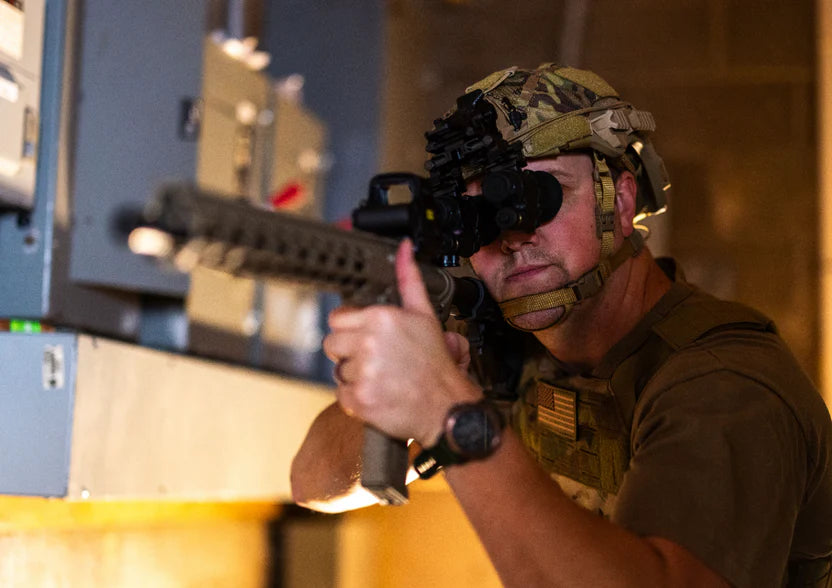
A digital night vision helmet setup is popular for active users because it keeps your hands free. It’s useful for
- walking on trails or rough ground
- moving through the brush
- scanning while carrying gear, especially when paired with a handheld or weapon-mounted thermal sight
Binocular Viewing
A digital night vision binocular setup can feel comfortable for long observation since both eyes share the work. Many users prefer binocular viewing for longer monitoring sessions or wildlife observation.
The trade-off is usually added weight and bulk, which is why many people start with a monocular.
How Much Do Night Vision Goggles and Monoculars Cost?
The cost of night vision goggles varies mainly because the most expensive component is different between analog and digital.
Analog pricing is driven by the tube. Tube generation, performance tier, and component quality can affect the price. When durability and premium assembly are added, analog systems can become a significant investment.
Digital pricing tends to cover a broader range because it benefits from consumer sensor and display development. Built-in recording and adjustable screen controls are also common, which may reduce the need for extra accessories.

Which Night Vision Option Fits Professional and Outdoor Needs Best?
Outdoor and professional use place different demands on night vision, so the “best” option depends on how you operate at night.
Why Digital Night Vision Fits Most Civilian Users
Digital night vision fits civilian needs well because of its convenience:
- Easier transitions between lighting conditions
- Built-in recording
- Flexible screen control settings that adapt to terrain
- Improving refresh rates makes digital systems comfortable and adaptable
When Analog Night Vision Still Makes Sense
- Operate in extremely low ambient light
- Prioritize the most natural motion feel
- Rely heavily on passive viewing without infrared illumination
Many experienced users still trust analog goggles for confident movement in deep darkness.
Choose digital first if recording, easier ownership, and flexible use across changing light conditions matter more in your routine.
Choose analog first if passive low-light performance and natural motion are your priorities, and you’re prepared to handle bright-light precautions carefully.
Both digital and analog night vision systems can perform well for outdoor and professional use. The best match is the one you can wear comfortably, operate confidently, and trust during real movement at night.
FAQs
Q1: Do digital night vision goggles work without infrared (IR) light?
Yes, but performance depends on ambient light. In areas with moonlight or nearby lighting, many digital NVGs can work passively. In deep darkness, most digital systems need IR illumination to keep the image clear and usable.
Q2: Can night vision goggles see through fog, rain, or snow?
Not very well. Fog, rain, and snow scatter light and IR, which reduces contrast and makes the image look hazy. Lower IR power can help reduce glare, but visibility and identification range will still drop noticeably.
Q3: What is “blooming,” and why does it matter?
Blooming is when a bright light source overwhelms the image and spreads into surrounding areas. It can hide details and make scanning uncomfortable. Good systems control blooming, so you keep usable detail in both bright and dark parts of the scene.
Q4: How long do night vision goggles typically last on a battery?
Runtime varies by brightness settings, IR use, and whether recording or Wi-Fi is active. Many digital units last a few hours per charge, while analog systems often run longer. Cold weather can reduce battery life and performance for both types.
Q5: Are night vision goggles hard to focus on for new users?
They can be at first. Most devices require adjusting both the eyepiece and the objective lens. A simple rule is to set the eyepiece for a sharp screen first, then focus the front lens for the target distance. After that, it becomes routine.


Leave a comment
All comments are moderated before being published.
This site is protected by hCaptcha and the hCaptcha Privacy Policy and Terms of Service apply.