
Most people shopping for night vision start with one question: goggles or binoculars? The answer has less to do with specs and more to do with what you actually do in the dark. Terrain, movement patterns, and how many hours you stay out all push you toward different gear. This comparison covers both formats honestly, so you can match the device to your real outdoor routine.
What Are You Actually Doing Outdoors at Night?
The way you move at night defines which format makes sense. Night hiking, patrol training, Airsoft Milsim events, and wildlife observation all look very different in low-light conditions, and each one puts different demands on your optics.
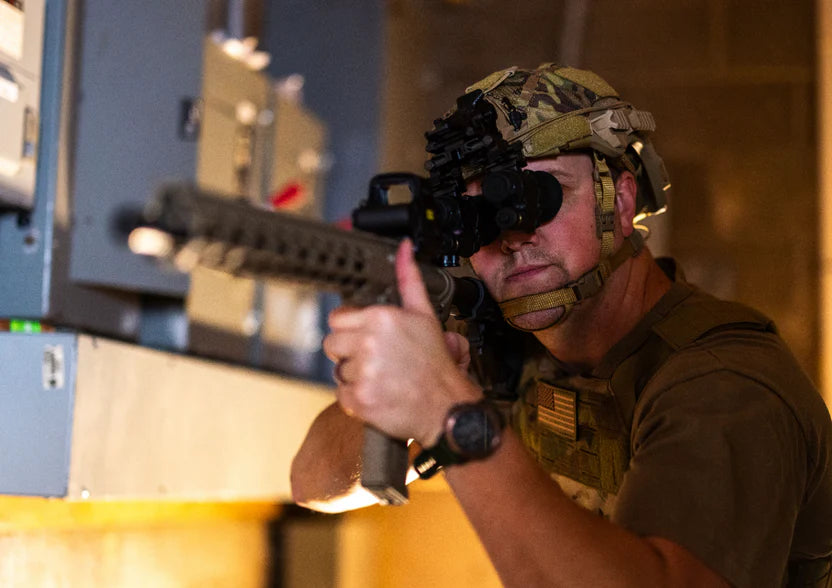
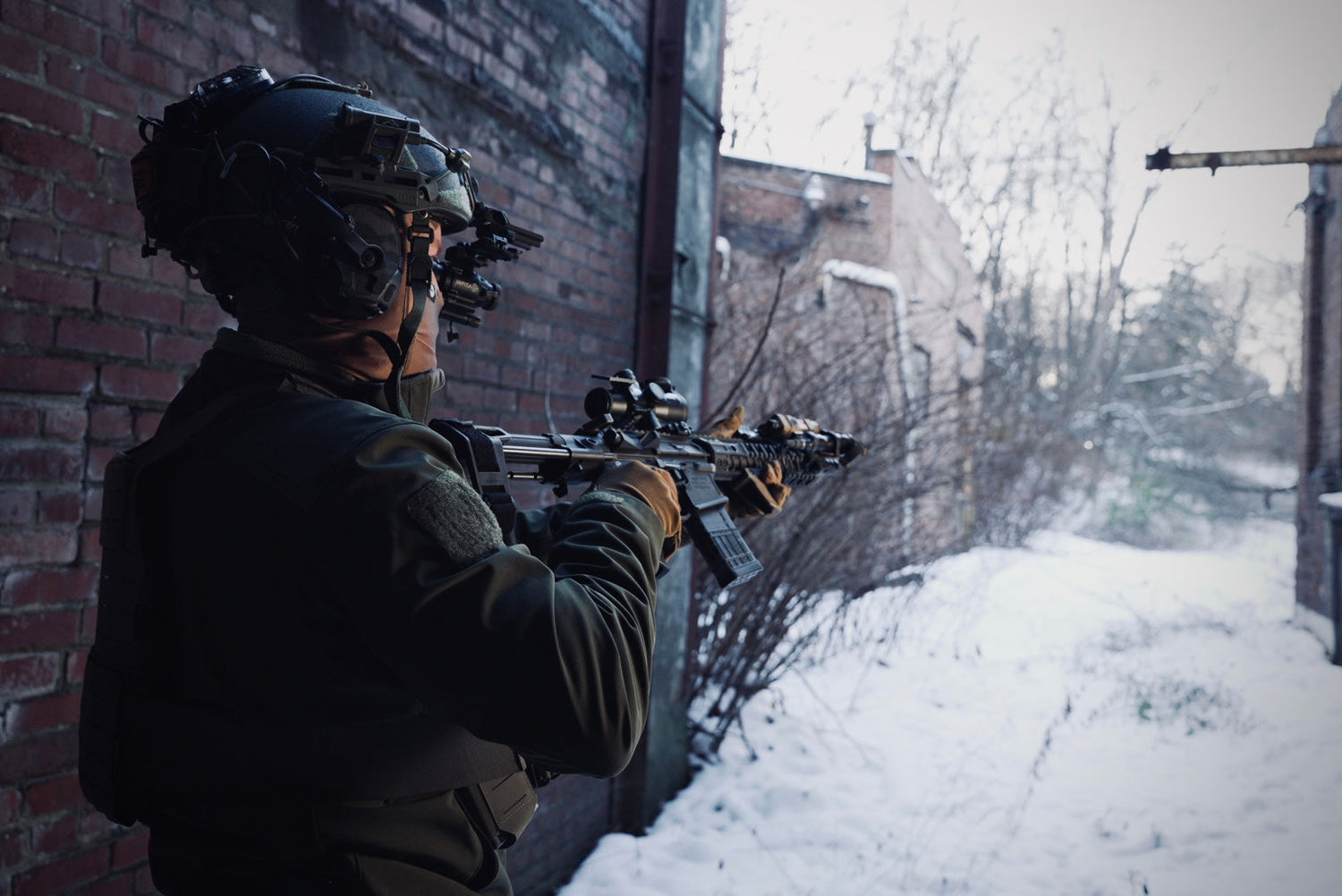
Head-mounted night vision goggles, whether single-tube monoculars or dual-tube systems, are designed to sit on your head and stay there. Handheld night vision binoculars are designed to be raised, focused, and lowered. That one difference in how you hold and use each device shapes everything else about the comparison.
Here's a baseline overview before getting into specifics:
| Feature | Night Vision Goggles | Night Vision Binoculars |
| Mounting style | Helmet or head strap | Hand-held |
| Hands-free operation | Yes | No |
| Magnification | Typically 1x | Built-in 2x–8x+ |
| Field of view | Wide | Narrower at higher magnification |
| Best suited for | Navigation, movement, patrol | Fixed-position, long-distance viewing |
| Weight range | Lighter (single tube) | Heavier (dual optics + larger lenses) |
Goggles are the standard choice for any outdoor scenario that requires sustained movement. Binoculars serve a different purpose: they're most useful when you've stopped moving and need to identify what's farther ahead.

Night Vision Goggles DNVS-14 Pro
When Do Goggles Give You the Edge While Moving?
Moving through unlit trail sections at night, you're constantly switching between checking your footing and scanning the area ahead. Every time you have to raise a device to your face and lower it again, you lose a step of situational awareness. That friction adds up fast over a long outing.
The practical advantage of night vision goggles during movement comes down to one thing: your hands stay free. Once mounted to a helmet or head strap, you can check your footing, manage gear, or stay ready without removing anything from your face.
At 1x magnification, goggles give you a wide field of view that captures the full environment around you. During dynamic movement, that spatial awareness is far more useful than a zoomed-in image of a single distant point.
Specific outdoor scenarios where goggles consistently outperform binoculars:
- Night navigation on foot across trails, forest paths, or unlit terrain
- Close-range movement in low-visibility environments
- Dynamic scanning while repositioning or transitioning between areas
- An extended patrol where hands-free operation is a safety requirement
- Driving or ATV use in off-road, low-light conditions
Refresh rate (Hz) matters here, too, especially with digital night vision goggles. Older digital devices produce visible motion blur during fast head turns, which makes navigation feel disorienting. Higher-end digital night vision goggles running at 60Hz or 100Hz can significantly reduce motion blur and perceived lag, making fast head movements feel considerably more natural. The image keeps up with your head movement and stays stable even during quick transitions. Analog goggles with image intensifier tubes work differently. There's no digital processing involved, so the image is real-time with zero lag, making analog the preferred format in fast-paced scenarios where any processing delay is noticeable.

Why Do Binoculars Still Make Sense for Stationary Observation?
Not every outdoor situation involves movement. If you've reached a fixed observation point and you're watching open ground for the next two hours, the priorities shift entirely. Now the question is how clearly you can see what's far ahead, and for how long you can keep your eyes comfortable doing it.
Night vision binoculars have a clear advantage in this context. Two eyepieces working together reduce eye strain during long sessions, which matters when you're watching a fixed area over an extended period. Built-in magnification lets you identify details at a distance that 1x goggles won't resolve clearly.
The same magnification that helps at range creates real problems in other situations:
- The field of view narrows significantly at higher magnification, making it harder to track movement
- Helmet mounting is not practical with most binoculars due to weight, so you're always holding them
- Objects at close range appear oversized, which makes navigation disorienting
- You're always zoomed in with fixed magnification, even when a wider view would serve you better
How Does Weight and Bulk Add Up Over Hours of Use?
An hour of wearing night vision feels very different from six hours. Weight accumulates as fatigue faster than most people expect, particularly when it sits in the front of a helmet or head strap.
Lightweight night vision goggles, particularly single-tube monoculars, typically come in under 300 grams. That's comfortable for a full night of use without significant neck strain building up.
Binoculars are heavier by design. Dual optical systems, larger objective lenses, and the additional housing all add to the total. Most night vision binoculars weigh between 600g and 1.5kg, which is manageable for short observation windows but becomes physically taxing over several hours of continuous use.
Key factors to check before committing to a device for extended outdoor use:
| Factor | Why It Matters for Long Sessions |
| Housing material | Magnesium alloy is significantly lighter than polymer at equivalent durability |
| Battery system | Replaceable cells allow runtime extension without carrying a charger |
| Mount design | Proper helmet mounts distribute weight more evenly than basic head straps |
| Single vs. dual tube | Dual tube improves depth perception but adds meaningful weight |
Battery life is part of the weight equation, too. Lightweight night vision goggles with a single-cell power system simplify logistics on longer outings. Some analog configurations reach 50+ hours of runtime without the IR illuminator active, reducing the need to swap batteries frequently, even on extended outings.
Which Format Handles Mixed Light and Changing Terrain Better?
Outdoor conditions don't stay consistent. A trail that starts in full darkness might pass through areas lit by moonlight, open sky, or distant artificial sources. The device needs to manage those shifts without asking you to stop and adjust settings manually.
Analog night vision goggles perform best in stable, consistently dark environments. They amplify available light efficiently and deliver a real-time image with no processing delay. The main limitation is sudden bright light exposure. A direct flashlight or vehicle headlamp can temporarily overwhelm the tube, and in extreme cases, cause lasting damage.
Digital night vision goggles are more forgiving when conditions shift. The image sensor handles rapid changes in brightness automatically. Moving from dense tree cover into a moonlit clearing, for example, the display adjusts without the image blowing out. For terrain that moves between different lighting conditions across a single outing, that adaptability reduces the number of moments where you're essentially blind during the transition.
Night vision binoculars face the same ambient light challenges, and the added complication of fixed magnification on changing terrain. Every time the environment shifts, from open ground to dense cover or from flat trail to steep drop, you're refocusing and reframing constantly, which interrupts movement and slows decision-making.

Choose the Night Vision Format That Fits the Way You Move
For outdoor use that involves regular movement, night vision goggles are the practical choice. They keep your hands free, suit extended wear in lightweight configurations, and hold up across variable lighting and terrain. Night vision binoculars are genuinely useful for stationary, long-range observation, and they do that job well. For mixed-use scenarios requiring both mobility and occasional distance viewing, options include a helmet-mounted goggle paired with a front-mounted magnifier attachment, or a digital night vision goggle with built-in electronic zoom. Both approaches cover more ground than carrying a standalone binocular setup.
FAQs about night vision goggles: capabilities, legality
Q1: Can night vision goggles be used in total darkness with no ambient light?
Yes, as long as the device has a built-in IR illuminator. Without one, image intensifier tubes require at least some ambient light to produce a usable image.
Q2: Do night vision goggles work in rain or fog?
Partially. Light rain and mist have minimal impact on performance. Dense fog reduces visibility because IR light scatters in heavy moisture, shortening the effective range noticeably.
Q3: Is night vision legal for civilians to own and use outdoors?
In the U.S., civilian ownership of many night vision devices is generally permitted, but rules on outdoor use, weapon mounting, outdoor applications, and export vary by state and by product classification. Users should always check current local regulations before use.
Q4: What is the difference between night vision and thermal imaging for outdoor use?
Night vision amplifies available light to show detail and texture. Thermal imaging detects body heat regardless of light conditions. Thermal identifies presence faster; night vision shows finer environmental detail.
Q5: How far can night vision goggles realistically see outdoors?
Gen 2+ devices typically detect a person-sized target at 200 to 300 meters under natural ambient light. An active IR illuminator extends usable range in complete darkness.


Leave a comment
All comments are moderated before being published.
This site is protected by hCaptcha and the hCaptcha Privacy Policy and Terms of Service apply.